
Quel est le prix d’un diagnostic électronique pour votre véhicule ?
Les bases du diagnostic électronique : comprendre son rôle et son utilité pour votre véhicule Lorsque le témoin d’alerte s’allume sur votre…
Lire l’article →
When a car exhibits vibration on startup, also known as engine shake, it signals an underlying mechanical or electrical imbalance within the vehicle’s powertrain. This issue, often described as a car shaking or car tremble, can be unsettling for any driver and may indicate more serious troubles if left unaddressed. The phenomenon usually happens when the engine is cold and idling roughly, with vibrations felt through the steering wheel or floorboard.
One of the most frequent culprits behind these vibrations is an engine misfire, caused by problems in the ignition system such as worn spark plugs or defective ignition coils. In gasoline engines, misfiring can lead to erratic combustion, which transmits uneven energy through the engine mounts and chassis. Modern engines typically idle at about 750 RPM, and steady operation at this speed is a sign of a healthy ignition and combustion cycle.
Manufacturers like Peugeot and Renault have made remarkable advances since 2010, integrating piezoelectric fuel injectors that reduce early vibrations by nearly 40%. However, on many used vehicles, cumulative wear revives these shaking symptoms. Diagnostic tools now routinely check sensors that monitor crankshaft and camshaft positions. Failures in these components cause RPM fluctuations that translate directly to noticeable engine trembling on startup.
Identifying whether vibrations are axial (front-to-back) or lateral (side-to-side) helps pinpoint components like exhaust systems or specific cylinders causing the imbalance. Today, free smartphone apps enhanced with vibration sensors assist many drivers in detecting vibrational amplitudes, helping determine if an early professional intervention is needed.
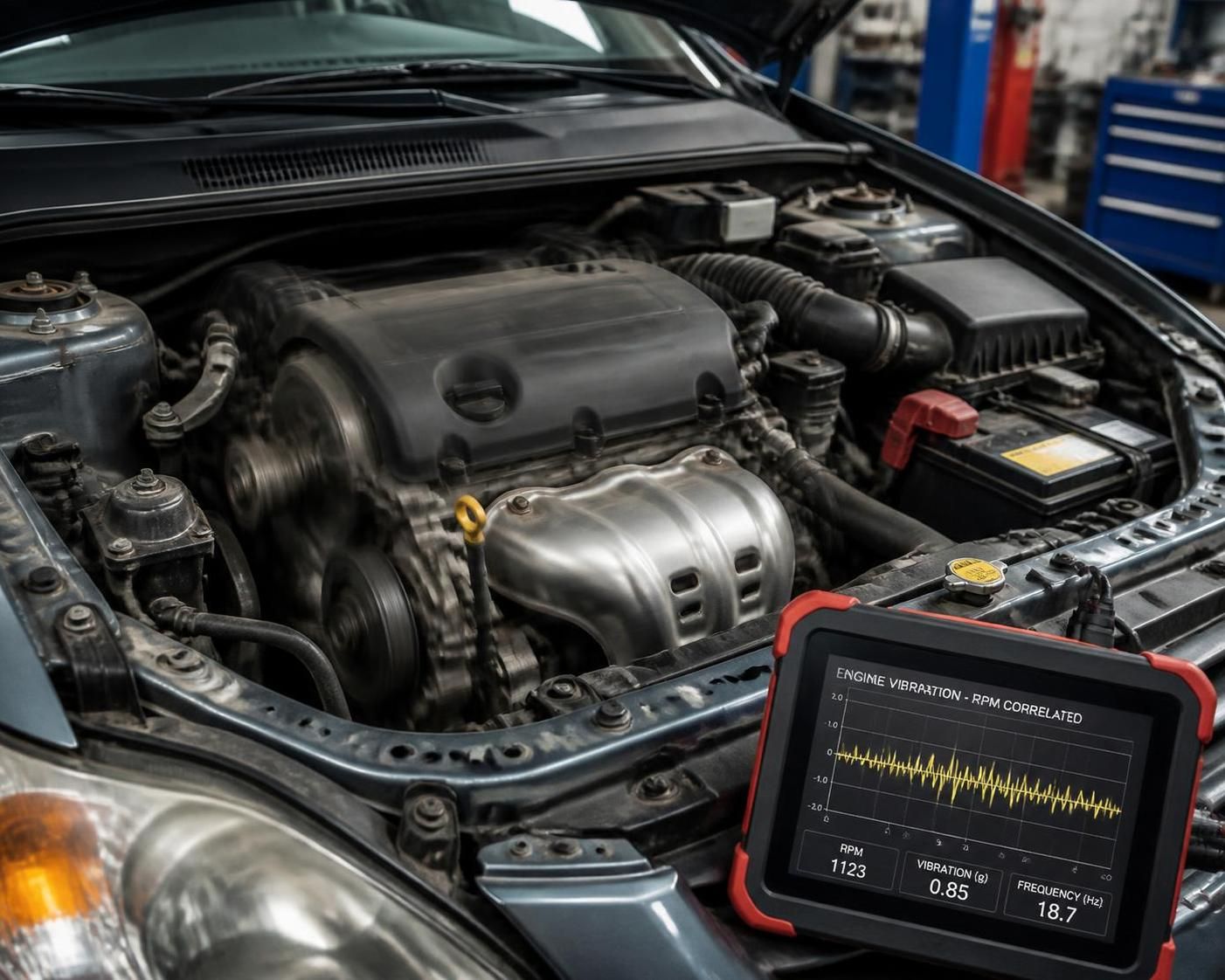
Ambient temperature plays a significant role in the intensity of car tremble at engine startup. At low temperatures around 5°C, the engine oil thickens by approximately 20%, which restricts lubrication of moving parts such as bearings and pistons, generating irregular mechanical resistance. Consequently, the engine struggles to stabilize its idle until it warms up to around 80°C within a few minutes.
Diesel engines, in particular, suffer more pronounced vibrations due to the glow plug system’s delayed or weakened operation during cold starts. Studies from the UTAC in 2022 report that about 25% of diesel vehicles demonstrate shaky cold startups traced back to glow plug degradation. These plugs heat the combustion chamber to facilitate ignition since diesel engines do not use spark plugs.
On the other hand, spark plug issues remain a consistent cause of vibration in gasoline engines during startup. Worn or fouled spark plugs can cause a misfire rate increase, so the engine runs unevenly with reduced RPM, typically as low as 600 RPM. Replacement of spark plugs with durable iridium tips can reduce vibrations by enhancing spark timing and combustion efficiency, albeit with added upfront costs.
Digital engine control units (ECUs) now monitor misfires with error codes such as P0300, which automotive workshops can diagnose with affordable OBD-II scanners costing under 30 euros. This diagnostic approach is essential for early detection to avoid damage to catalytic converters or excessive fuel consumption due to poor combustion.
Additionally, hybrid vehicles like the Toyota Prius incorporate electric motor torque that compensates for combustion irregularities, reducing vibrations almost entirely at startup. However, their complex battery and electrical systems require precise technical expertise for troubleshooting beyond standard mechanical diagnostics.
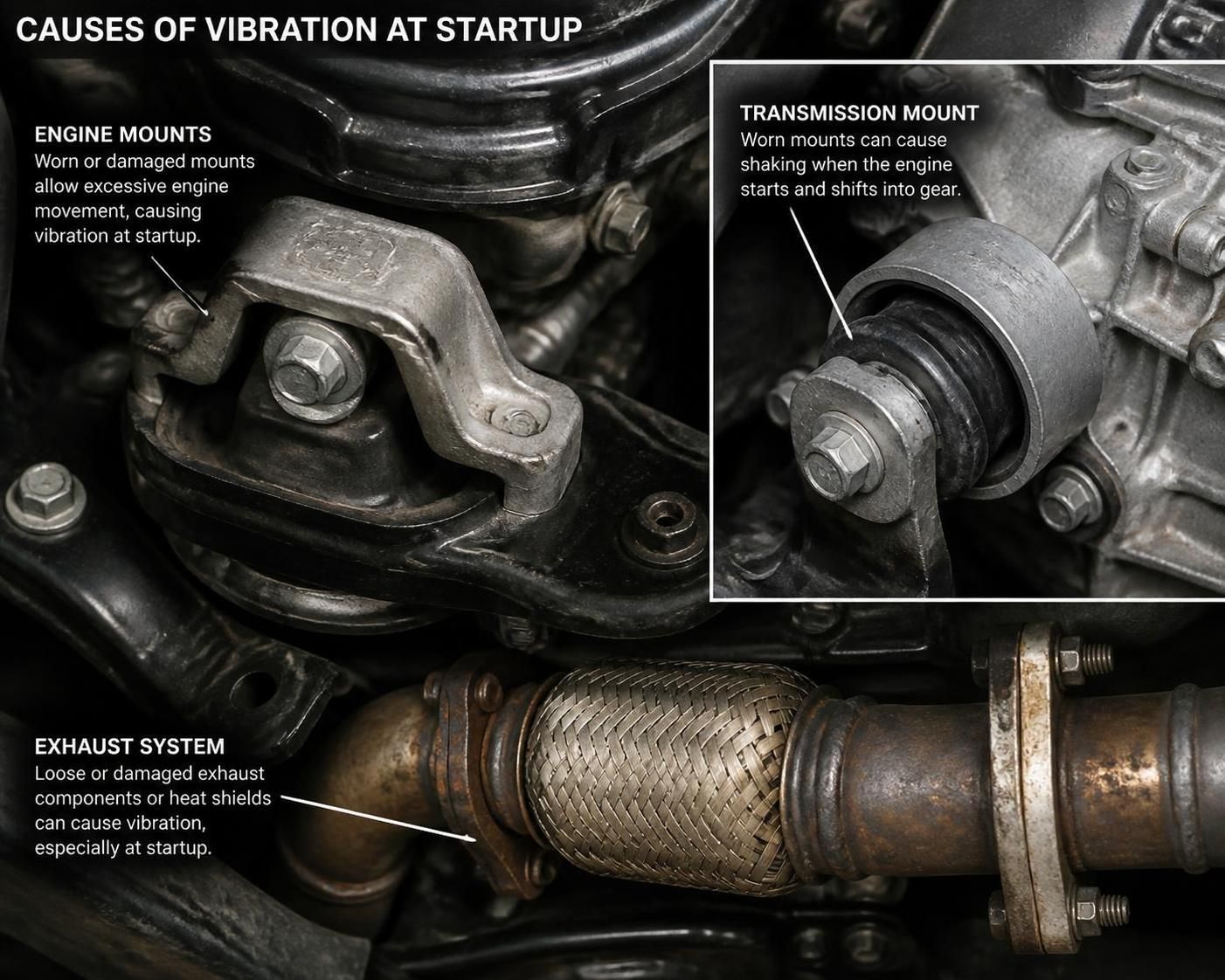
Engine supports and motor mounts are frequently overlooked but critical in dampening vibrations from the engine block. According to ADAC’s 2023 survey, approximately 35% of vibration complaints stem from cracked or hardened motor mounts. This rubber-metal component absorbs shock waves emanating from cylinder explosions which can reach up to 50 bars of pressure. When vandalized or aged beyond 80,000 km, damaged mounts transmit vibration directly to the chassis, intensifying the perceived shaking at startup.
Visual inspection of mounts reveals cracked or swollen rubber, indicating imminent failure. Replacing a front engine mount on a typical 1.6-liter gasoline engine usually costs around 250 euros in parts and labor, with a single mount replacement stabilizing engine vibrations in 80% of cases. Ignoring this can accelerate wear on other drivetrain components due to unmitigated shocks.
Other mechanical suspects impacting startup vibrations include worn connecting rods or bent crankshafts. Although such serious damage is rare before 150,000 km, it manifests as audible knocking at around 2,000 RPM and notable engine shaking. Diagnosis through advanced oscilloscopic tools allows measuring timing variations between cylinders, which directly relates to imbalance.
Flywheels equipped with dual-mass systems on 70% of modern diesels deteriorate after 120,000 km, causing tremors and clutch issues. Pricing for new dual-mass flywheels can reach 600 euros. Proper diagnosis involves clutch hydraulic bleeding and testing engagement behavior to differentiate from simpler drivetrain faults prevalent in gasoline vehicles, where mono-mass flywheels generally last much longer.
The exhaust system can sometimes cause startup shaking if internal flex pipes are damaged, resonating around 40 Hz vibrations. Repairs usually cost about 100 euros. Furthermore, dirty oxygen sensors (Lambda sensors) affect fuel-air mixture regulation, exacerbating vibrations by creating richer combustion cycles by 15%.
Among the foremost reasons for vibrations on startup are spark plug issues and ignition coil deterioration. Spark plugs notoriously suffer from electrode wear and deposits, increasing spark gaps from 0.8 to 1.2 mm over 30,000 km. This widens the ignition arc, resulting in incomplete combustion—up to 20% of combustion events may fail. Typical symptoms include a distinct smell of unburnt fuel and a lowered idle speed.
Switching to iridium spark plugs offers a 40% lifespan extension and more consistent ignition, though unit price sits near 12 euros. On vehicles from manufacturers like Volkswagen and Ford, ignition coils degrade due to overheating, dropping voltage delivery from 40kV to 25kV, leading to blackened plugs and misfires. A practical test is to swap coils between cylinders; if the misfire follows the coil, it must be replaced at approximately 80 euros each.
High-tension wiring can leak significant voltage after a decade, wasting 5kV and sparking misfires that are notoriously overlooked in 40% of amateur diagnoses. Replacing the entire ignition set—including four plugs, wires, and coils—is recommended to prevent recurrent vibrations and reduce workshop return visits by 70%.
| Component | Common Failure Sign | Replacement Cost | Recommended Replacement Interval |
|---|---|---|---|
| Spark Plugs (Iridium) | Engine misfire, rough idle, unburnt fuel smell | ~12 euros each | Every 30,000 to 60,000 km |
| Ignition Coil | Blackened spark plugs, misfires follow coil in swap test | ~80 euros each | 80,000 km or on symptoms |
| High-tension Wires | Voltage leakage, rough running, ignition faults | ~50 euros for full set | 10 years or signs of wear |
These diagnostics and repairs should be prioritized before exploring more complex causes because ignition system defects account for nearly 30% of startup vibrations. For a comprehensive guide, professional advice can be found on engine troubleshooting and ignition problems, which explains detailed symptom analysis for car owners.
Fuel injectors play a crucial role in delivering the correct amount of fuel for combustion. A car shaking or idle vibration experienced during startup is often linked to clogged or malfunctioning injectors that spray fuel unevenly, producing an inconsistent air-fuel mixture. This irregularity leads to rough idling, reduced power, and increased emissions.
Direct injection systems, especially common in diesel engines running high-pressure fuel at 2,000 bars, are particularly vulnerable to dirt and debris. A blocked injector may deliver 10% less fuel, causing the engine idle speed to fluctuate up to 150 RPM from its target. Ultrasonic cleaning restores injector function in about 65% of cases at a service cost near 80 euros, but severe clogging demands replacements costing around 200 euros per injector.
Emission control components like the EGR (Exhaust Gas Recirculation) valve becoming clogged can worsen shaking by recirculating dirty gases that disrupt combustion, increasing vibration intensity by up to 25%. Regular maintenance by purging the EGR every 50,000 km is recommended to prevent these issues from escalating.
Fuel pump degradation is less frequent but equally impactful. A failing high-pressure pump can cause pressure drops that lead to erratic engine behavior and shaking at startup, with repairs sometimes reaching 800 euros. Testing fuel line pressure—roughly 3 bars for gasoline and 300 bars for diesel—is essential to diagnose this concern accurately.
For drivers interested in diving deeper into injector-related causes, authoritative manuals like those found at Auto-Doc’s guide on vibration causes provide comprehensive overviews, including how to differentiate between mechanical and injection system faults.
Engine mounts, also called silent blocks, absorb the powerful pulses created by engine combustion cycles. These components feature complex hydraulic inserts that wear out after about 90,000 km, losing their damping efficiency. The result is a noticeable increase of vibration amplitude up to 0.8 g felt through the cabin, often at frequencies around 50 Hz.
This wear is especially common among popular models such as PSA’s 208, which accounts for nearly half of all mount-related complaints. The replacement procedure typically requires two hours of mechanical labor, priced around 300 euros for original parts. Choosing aftermarket mounts from non-certified brands risks faster failure; the difference can be as much as 50% shorter service life.
Other chassis components like front subframe bushings and control arm ball joints contribute to startup vibrations if deteriorated, amplifying shaking by 35%. This frequently causes minor loss of vehicle control, a factor linked to 15% of low-severity accidents per a 2022 TUV safety report. Proactive replacement of these bushings, which cost around 150 euros for a set, is advisable for safety and comfort.
Regular inspection of these mounts and chassis parts must be part of a thorough car maintenance routine to detect developing issues before vibrations worsen or lead to costly secondary damage. Workshops at Garage Crauzaz Nurieux can provide reliable diagnostic and replacement services, leveraging professional standards.

Les bases du diagnostic électronique : comprendre son rôle et son utilité pour votre véhicule Lorsque le témoin d’alerte s’allume sur votre…
Lire l’article →
Comprendre la valise de diagnostic automobile : fonctionnement et utilité La valise de diagnostic automobile est un outil devenu incontournable pour quiconque…
Lire l’article →
Comprendre les bases du diagnostic voiture pour un contrôle technique efficace Le diagnostic voiture est devenu une étape incontournable pour assurer la…
Lire l’article →